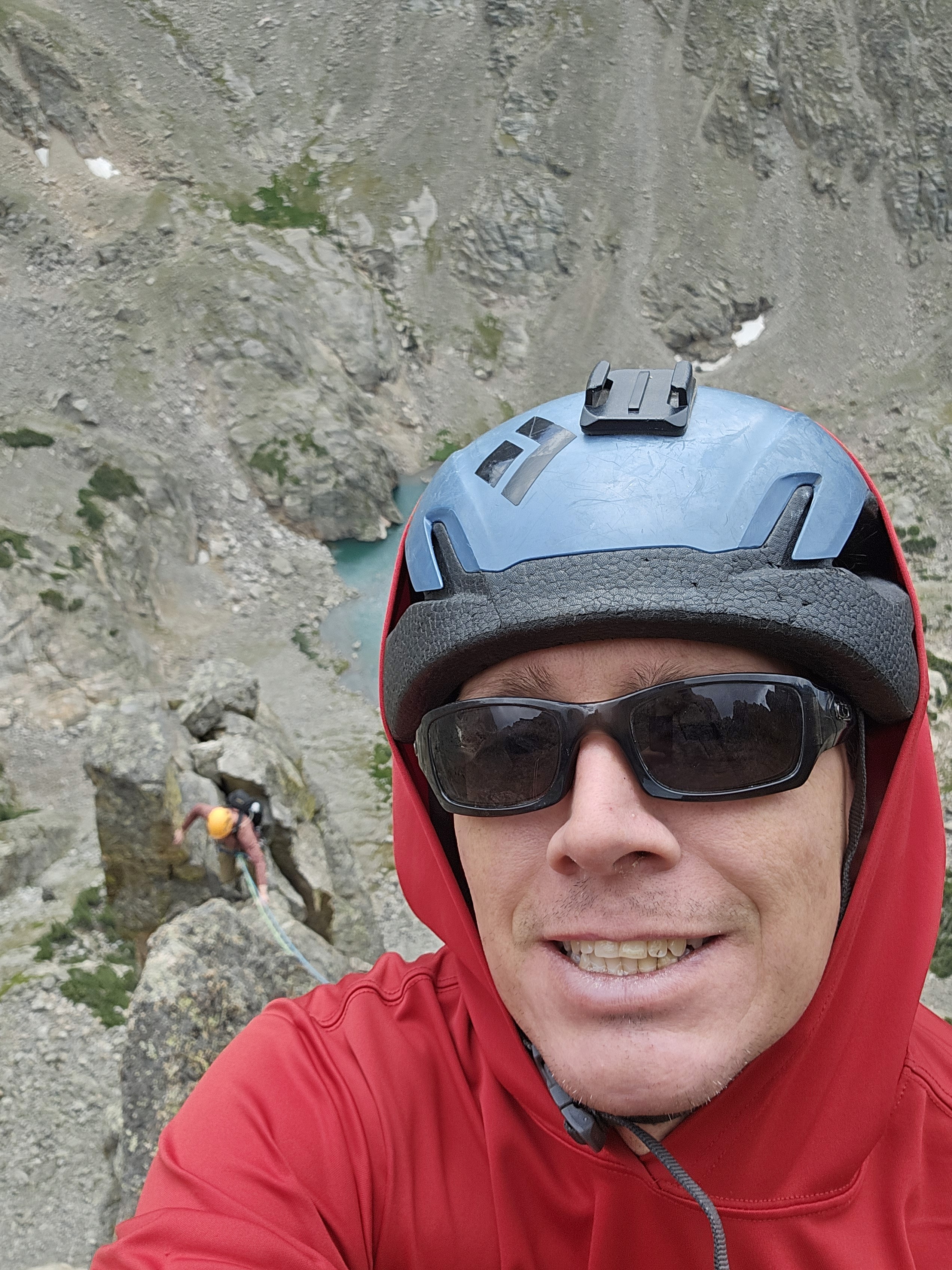

Petit Grepon's South Face is not only one of North America's 50 classic climbs but an excellent first step towards climbing The Diamond on Long's Peak. We switched our original plan because of weather but still had a great day of climbing. If you don't go you'll never know!
The Original Plan
The plan for the week originally called for a climbing order of Lumpy Ridge, Petit Grepon, a rest day, and finally The Diamond on Long's Peak (read about that here). With rain appearing in the forecast, we texted back and forth before rearranging things, moving Petit Grepon to the front of the trip but still sticking with Rocky Mountain National Park. While it wasn't ideal it worked out for more than just the weather. This client has climbed with us several times and has grown quickly in their skills. While they regularly hire guides they are also starting to trad climb on their own so this is a bit of a next step on their journey. Petit Grepon ended up being a good introduction to alpine climbing for them. A good challenge but not too overwhelming.
We left the trailhead at 5:15 a.m. and reached the base of Petit in a little under 2.5 hours. While we started with some dusky light it was great to watch the alpenglow start on the peaks as we got closer to treeline. Just before getting to Timberline Falls we rounded the corner to a few elk running and bounding around in a circle as they played in the meadow. With a small breeze it seemed like it was going to be a great day.
Since this was a warm up for climbing The Diamond the goal was not just to climb the South Face of the Petit but to see how he moved in a bigger alpine environment and how he was adjusting to the altitude. Being from Chicago it's a route I like using as a shakedown before The Diamond. It has cruxes that match the difficulty of something like The Casual Route, features double rope rappels, crack climbing sections, some easier chimneys, and enough distance that you get an idea of what someone's pace will be like on a longer alpine climb.
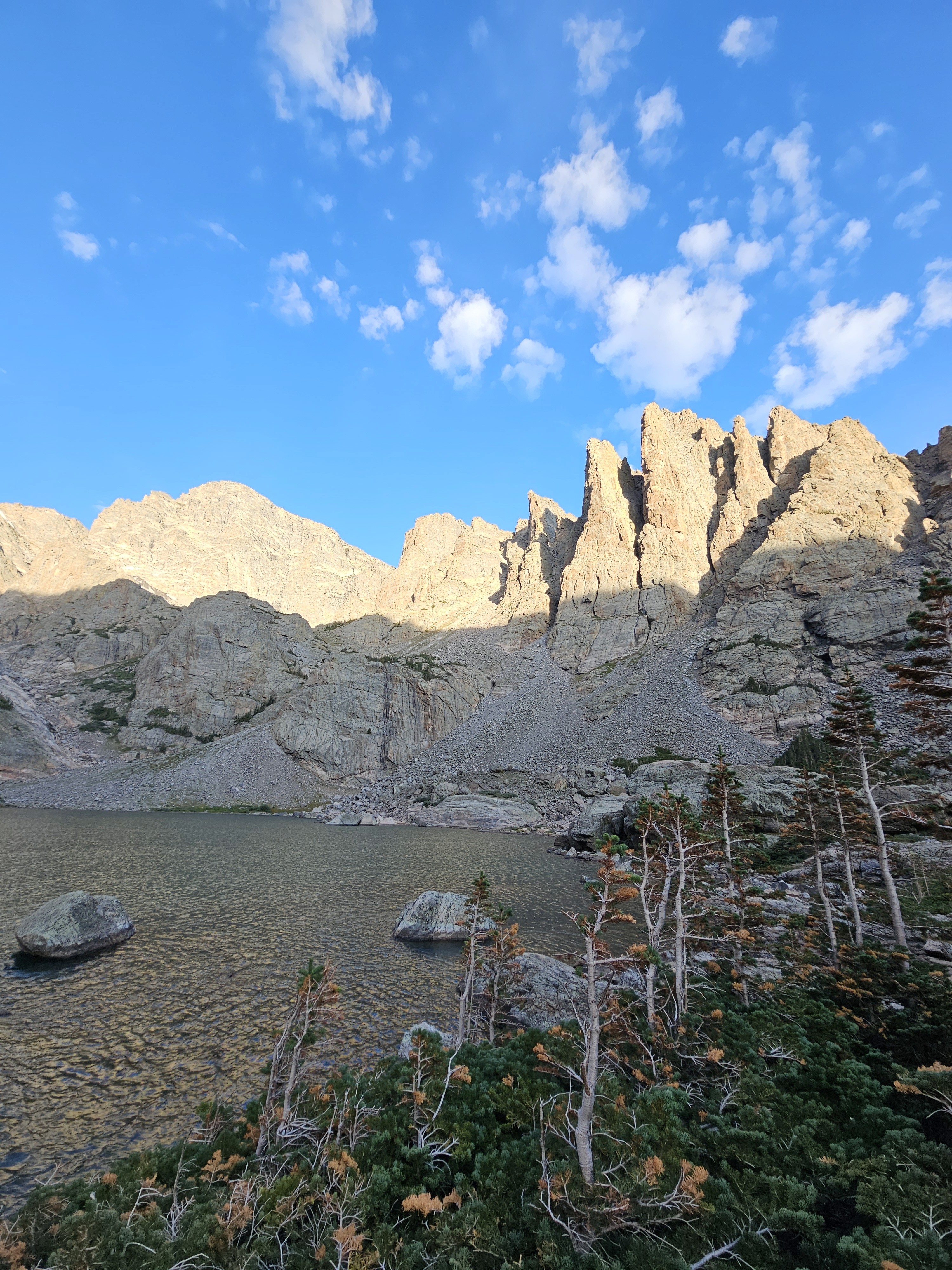
South Face of Petit Grepon Climbing
Light is right in the alpine so we had a small kit of a few nuts and double cams from 0.3 through 3, as well as ten slings, mostly alpine draws with a couple of quickdraws, and then basic anchor building and rescue kit. This is honestly plenty for The Petit. You could probably bring fewer cams and more nuts but when I'm guiding I find it moves faster to stick mostly with cams which brings me to my gear gripe. We lost a nut. I wasn't planning to place nuts since I didn't think we'd have to bail but at the end of a long pitch that was what worked best for the anchor. It was entirely my fault but if you find a nut on the South Face that comes out pretty easily with a nut tool you're welcome. The mountains giveth, the mountains taketh away.
I'm used to having lots of other parties to contend with, even on a weekday but in this instance we lucked out. One other party was already on the route, but they were efficient and despite my best efforts to catch them we got close near the top but never quite got to them. We had a little back and forth with a party on The Saber who let me know that the SE was better than the SW corner which I had done a couple years ago.
The weather window was the main reason Petit Grepon went first. While we had some wind and it spit down a little moisture I never saw any lightning or heard any thunder. Even though the forecast never really never materialized how we expected Petit Grepon was a logical first objective.
We could not realistically reverse the order and use The Diamond as the initial test of how the team would move together in the alpine environment because it's both bigger, higher, and more complicated. Petit Grepon gave us a lower consequence opportunity to work out things like communications and racking styles, pacing, transitions, and see how they handled the altitude before we did something above 13k.
The Summit and Descent
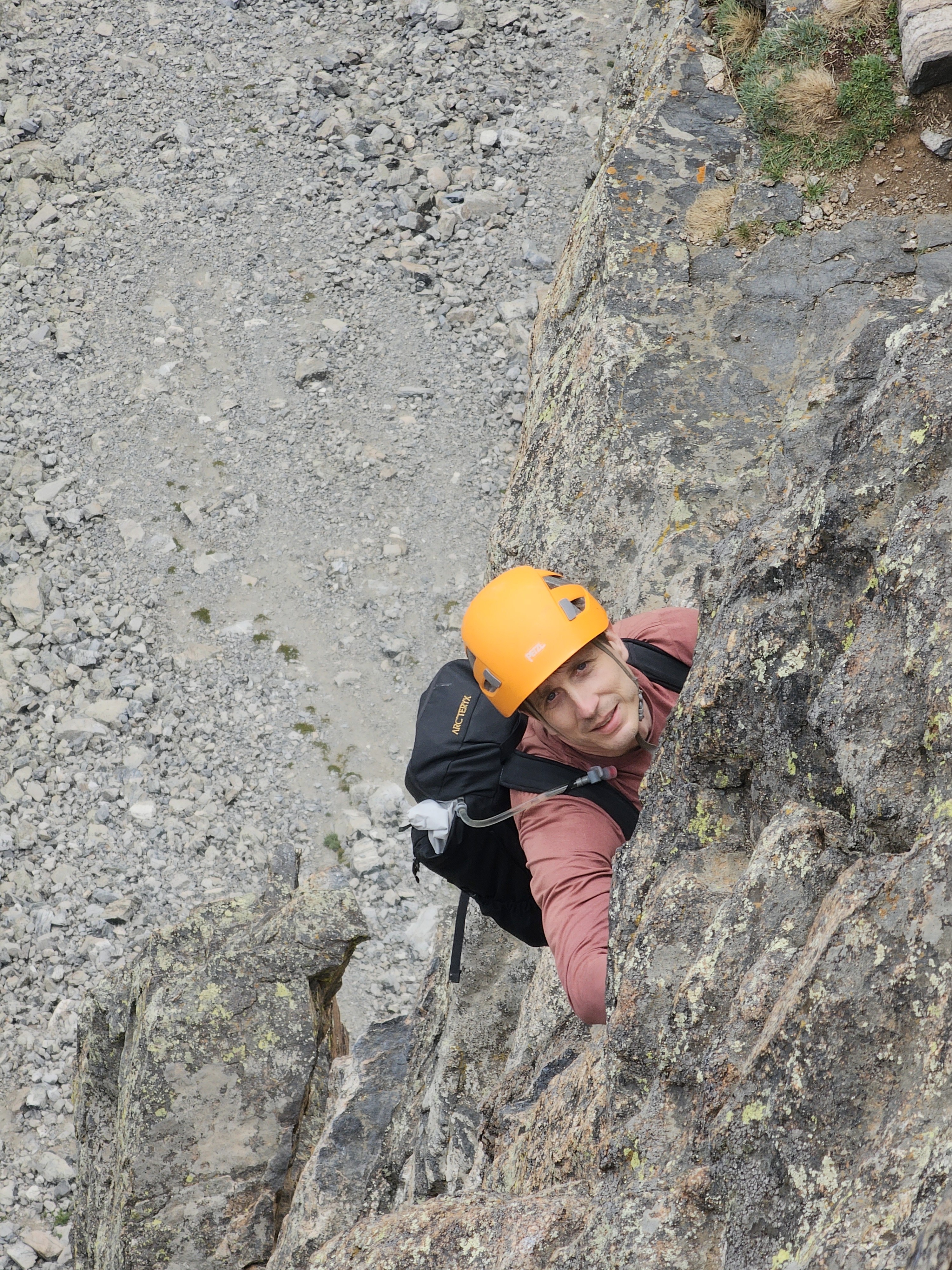
The Petit is always an enjoyable route and it went smooth as expected. We cruised up the first couple pitches of easy crack and chimney getting a flow going. Once we got to the crux I pulled the tough moves with my backpack on and got in a good position to take some pictures. While fatigue was starting to show up a little near the top we were able to enjoy the sun and continue cruising. Despite having to leave the nut on the second to last anchor we got up right at 2PM. I expected the other party to be hanging out but aside from the parallel party on The Saber we were alone. A few pictures later and we were on our way down. The easiest and in some ways my least favorite part.
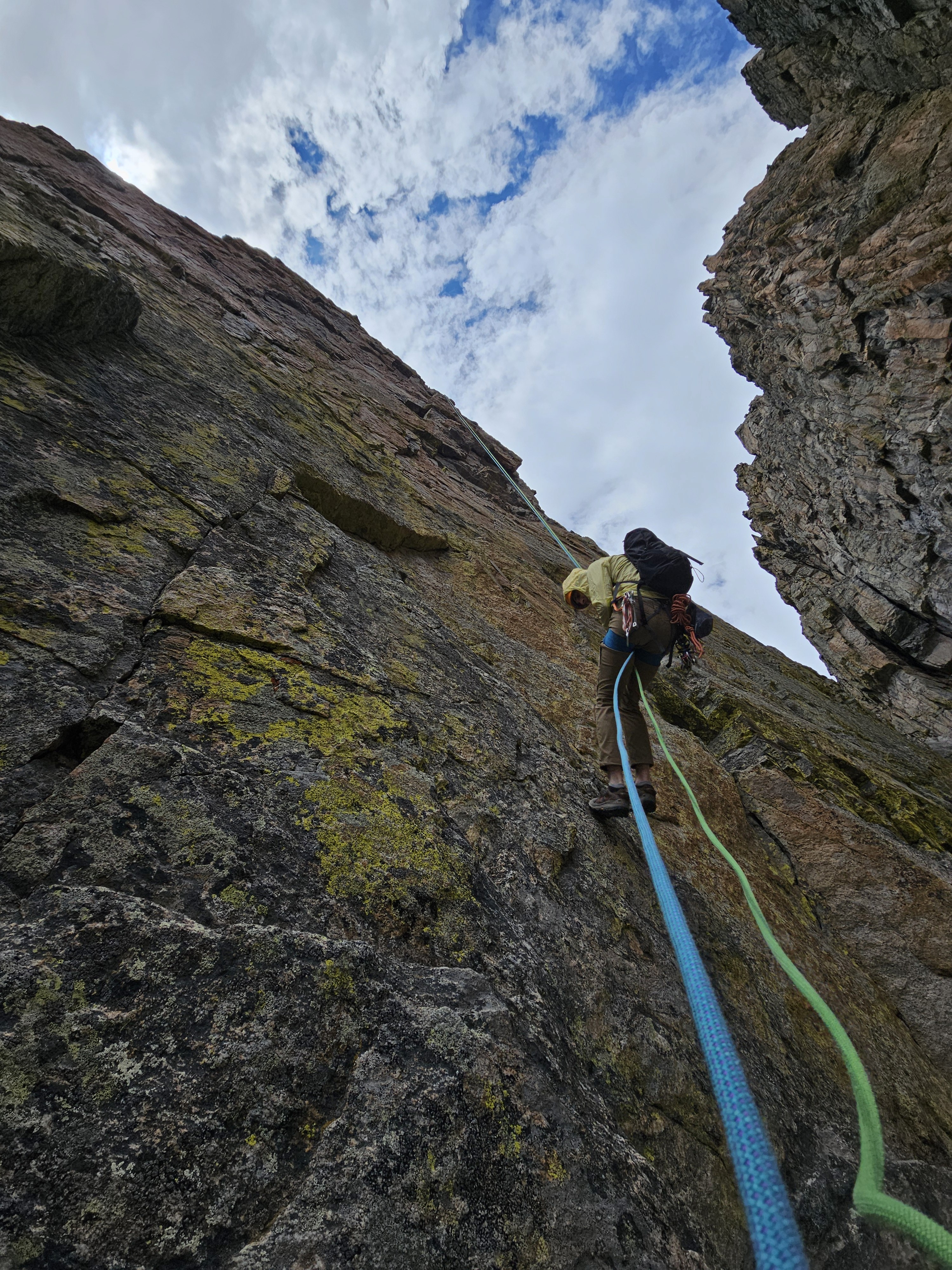
We used the standard rappel route, and finding the rappel stations is always a bit of a pain. while I've climbed The Petit over a dozen times the stations always feel closer than they need to be. The system is set up around double rope rappels which is fine but you don't end up going near the end of the rope and I think that makes for extra rappelling. I confirmed this with another guide, Buster, who thought it should just be bolted for a single rope. I'm fine either way but if we're going to set things up for double ropes we should probably go a bit closer to the end of the ropes on each rap. The second rappel in particular gives the impression that you're going to arrive at a ledge only to discover that another rappel is still required to get there. More a trivial annoyance than anything though.
Once back on the ground we packed up and began our hike out. A couple quick stops along the way near Alberta Falls and we were back at the trailhead just before darkness fell for a round trip time of 12 hours and 10 minutes. Not bad for taking our time on someone's first major alpine climb. The entire day had a great flow and a casual feel There was no dramatic moment or major obstacle to overcome, which was exactly what we wanted out of it. We got a beautiful morning in the Park, climbed a classic formation, established a good rhythm as a team, and came away with useful information for the bigger objective later in the week.
Conclusion
This was a good objective to use as practice before climbing on one of the most desirable high alpine walls in North America. Weather and movement ended up being the highlights of the day and we had no issues aside from a stuck nut.
Why is Petit Grepon a good shakedown for The Diamond?
Owing to it's lower altitude but having some distinct challenges like the crux pitch that is comparable to some of the more dangerous traverse pitches on something like The Casual Route, it gives a good idea if people have the minimum skills necessary to climb easiest route on The Diamond.
Is Petit Grepon really as classic as they say?
It has some great movement, great rock, good belay ledges, and the higher you go the more interesting the climbing gets. It's hard to compare to the many other classic climbs in Rocky Mountain National Park but it's definitely a favorite.
Are there alternate classics that are comparable?
The south face of Zowie is pretty good as well. It's not quite as long and the rock isn't quite as good but it's similar in character and also has an exciting summit. Ellingwood Arete is in the Sangre De Cristos but is another 50 Classic Climbs. It's a bit more alpine and not quite as hard but still pretty comparable.
Related posts
Keep reading with connected field notes, trip reports, and climbing tips from the guide team.


