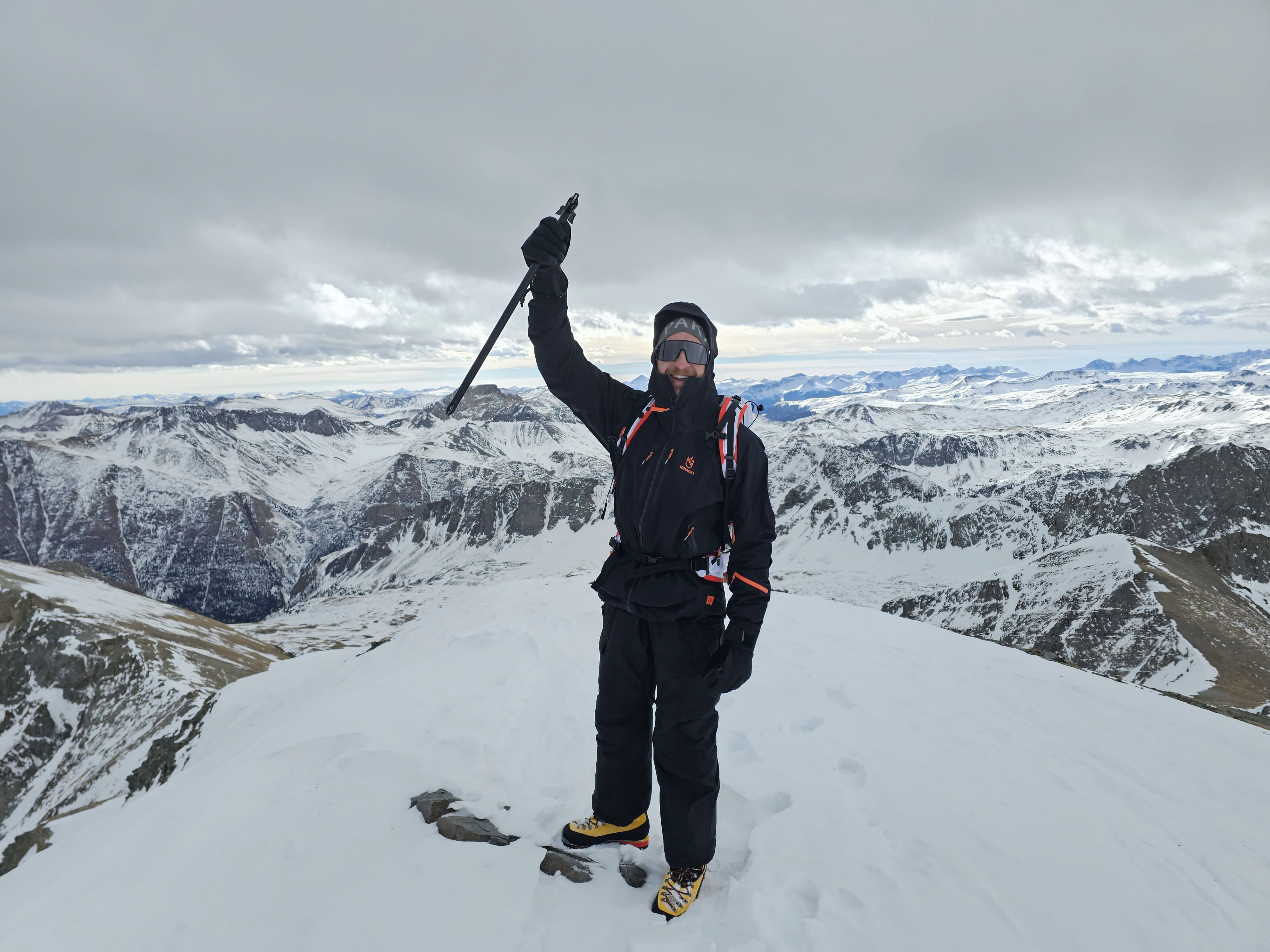

TL;DR Your best first 14er isn't the easiest one on paper; it's the one that matches your fitness, your vehicle, your tolerance for crowds and exposure, and how much time you can give it. Weigh scenery, logistics, crowds, and safety alongside the raw stats (terrain class, mileage, elevation gain, altitude). For most beginners, Mount Sherman is the gentlest introduction; Handies Peak is the best all-around first climb if you can handle the drive and road.
"How…much…farther?" My guest gasped as we took another break. "We're almost there, maybe another 15 minutes." Anyone who has done a 14er with me now is familiar with that lie. Could be 15 minutes, could be an hour, but we are in fact making progress and getting close. They did make it to the summit and back down safely but it reminded me of my own first 14er experience on Pikes Peak.
After spending the winter in upstate NY climbing 4000' peaks I decided to check out Colorado with the family and wanted to climb Pikes Peak. Not sure why I didn't think a 14er might be harder than a 4000er but showed up in full winter gear expecting Colorado to be cold and snowy which was a laugh when I got off in ski pants and it was 75 degrees out. Once I actually started I was definitely sweating but made it to the A-Frame where I couldn't get my stove to light. Despite having no water for the night and therefore nothing to eat I went ahead and persisted upwards the next day. Probably the only reason I made it was thanks to an older gentleman breaking trail after I'd been at it for 4 hours. He cruised off ahead thanks to likely superior rest, conditioning, and being well acclimated.

Author's first 14er after no water and minimal food for 24 hours.
What actually makes a good first 14er?
Your best first 14er is usually not the hardest, tallest, or most dramatic. It is a peak that best matches your fitness, the vehicle you own, your hiking experiences, and not just the least difficult. While I've not climbed all of the 14ers in Colorado I've accumulated well over 300 14er ascents having repeated some like Sherman, Crestone Needle, and Humboldt nearly 100 times for each of them.
Plenty of people hire us for their first 14er climb. They don't know what to expect and they're nervous. They've heard about afternoon thunderstorms and avalanches, rockfall, crowds, crazy roads. They keep hearing how great it is but they've never done anything like this before. They may have never really done any hiking and aren't sure it's for them.
A lot of people end up doing their first 14er out of Colorado peer pressure. Like rock climbing it's sort of a hobby that people just do here. Can you really call yourself a Coloradan if you haven't climbed to the summit of one of these lofty peaks? Sure you can but having done so gives you a bit more street cred. While many people make recommendations that are simply mathematical we think the decision should involve a bit more than the shortest mileage and elevation gain.
What makes something the best first 14er is your personal balance of:
Scenery: one of the big reasons we like 14ers are the views, the forest scenery, the craggy skyline and the big sky feeling. Some have this more than others. Handies Peak in the San Juan Mountains is often cited as one of the most beautiful of the 14ers. I've taken children as young as nine years old to the summit from the American Basin side. The flowers are beautiful, the lake is spectacular and it gives people that feeling of being dep in the mountains. Contrast that with Mt. Sherman which is another 14er we frequent for people's first time. It's covered in mining remnants. The surrounding peaks have a lot of mining history but it's a lot of slide rock. It's better for people in a different way but most people would not consider it the most scenic of the 14ers.
Logistics: 14ers are spread out through the state and depending on where you're coming from, what kind of vehicle you have, and what your time constraints are, you might consider different peaks. Coming from the Front Range a climb of Handies Peak all of a sudden might look less enticing since it entails a 4-6 hour drive. But it's great if you're visiting the Durango or Silverton area and have a capable vehicle. Driving to the trailheads and any passes or timed entry are a big thing to keep in mind. Mt. Sherman is much closer to the Front Range and you can get almost the entire way in a regular passenger vehicle. There are several other 14ers along the Front Range like Evans, Bierdstadt, Grays, and Torreys that have a mixture of timed entry, challenging roads, or crowds that have their own challenges.
Crowds: as climbing 14ers gets more popular you'll find you're not alone more often than not. Some places this applies more than others. An early season ascent of Handies Peak may find a few people along the way while a summer weekend on Bierdstadt will have you following a crowd of hundreds of people from Denver or the rest of the Front Range climbers as company. Once you become more accustomed to climbing these peaks you may find it something to avoid but for a lot of first time 14er climbers it can be a comfort to know there are other people around. You have less concerns about navigation (not that you should blindly follow other people), if you are worried about getting injured you know you won't be alone, and having a constant stream of people on their way down letting you know how close you are can be helpful psychologically. Often a lot of women on their first 14er climb feel more comfortable with a crowd around rather than running into someone by themselves in the middle of nowhere and nobody else around.
Safety: there are a few things that go into safety. One is the proximity of help. Hiking up Pikes Peak you won't feel very exposed to danger. You can see a major city, there's a train and a highway, there's a hut partway up one route. While there is real hazard and you aren't in a totally benign area there is quicker access to medical care. This will feel different from something like Humboldt where there is no city in the distance and you took a rough road to get there. It feels isolated and a bit more out there. Although both have competent SAR teams in the event of a serious injury in reality it is simply just easier to reach someone on one peak more than the other.
Another thing that goes into safety is terrain. 14ers vary from Class 1 to Class 5 which I'll explain more thoroughly later. If you are just starting out doing a fifth class route on a 14er is an actual climb which is unlikely to be the place you want to start. Even if you're a competent climber doing at least one walk up 14er, which is class 1 or 2 will give you a better idea of how you will fair on something more technical.
Balance is always an important thing to think about but we still have to climb to the summit so in the next section we'll talk about the aspects that contribute to the physical difficulty of the peaks
What Terrain Makes 14ers Feel Hardest?
In reality 14ers are just big tall hills. There are bigger mountains, steeper ones, some with more difficult terrain, but nowhere else in the United States has a higher concentration of peaks over 14,000' than Colorado. We take a lot of people on their first, their finisher, and many in between. There are just four things that contribute to how difficult climbing a 14er is. Technical Terrain, Mileage, Elevation Gain, and Altitude. The comparison below shows the difference between a few 14ers, some that are more beginner oriented and some that are for more experienced climbers.
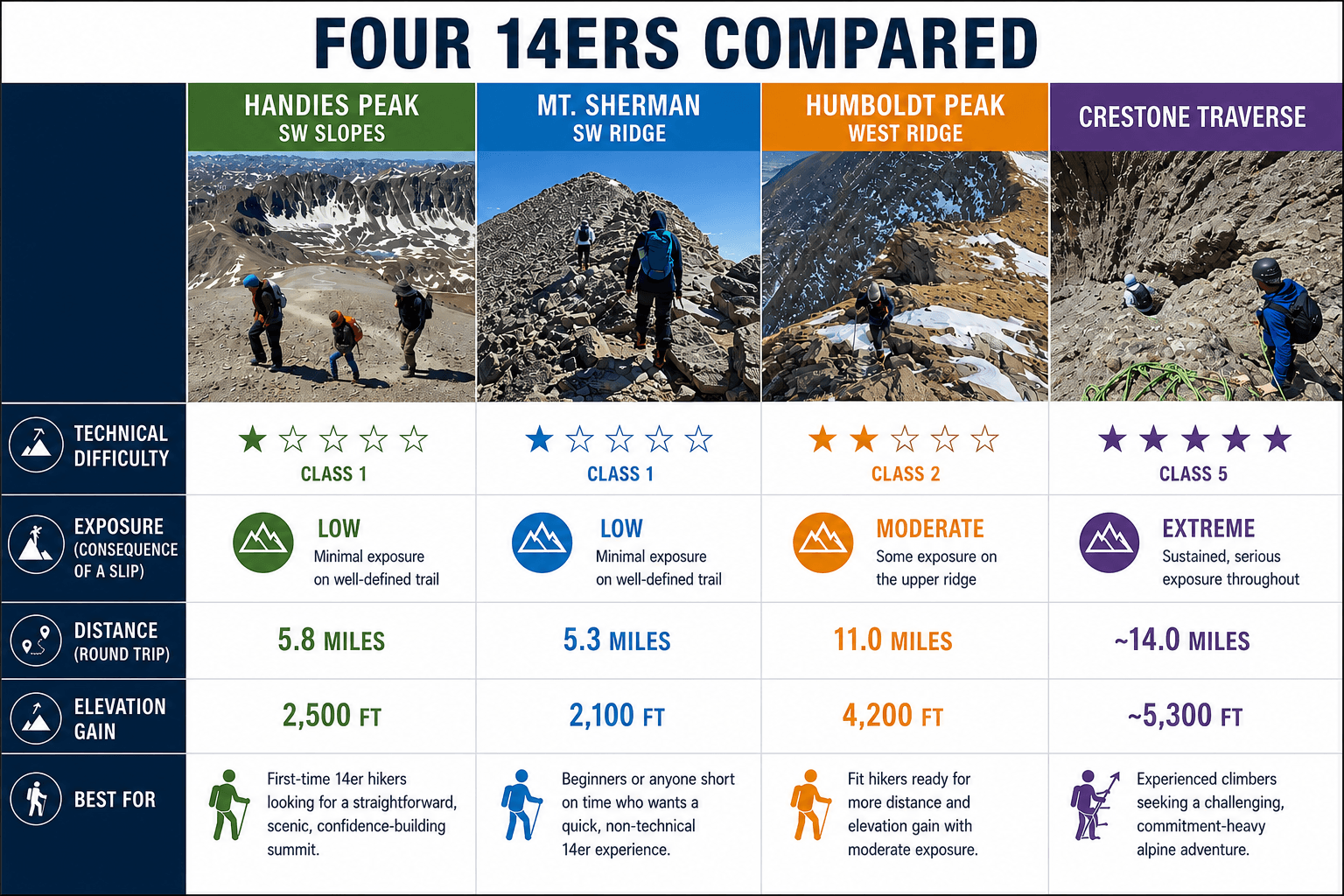
Technical Terrain:
With over 50 different peaks reaching above 14k there is going to be a lot of variation in terrain. While we only guide a handful of the easiest and the most difficult ones most of the guides at Colorado Climbing Company have had experience on many of them. Terrain is often identified from:
Class 1: These are hikes and require nothing more than walking to get to the summit. Their may be certain sections of trail that are a little steep or rough but in general you have a good trail to follow throughout. Route finding decisions are almost non-existent. There should be little to no risk of any major rock fall.
Class 2: These are also hikes but a bit rougher. There are places where you may put your hand down for a little balance but in general you're just walking. Sometimes the steps are very big. Trails are there for the most part but you might find the rougher sections harder to follow and experience following cairns is helpful (a cairn is a small pile of rocks used to mark trails and unless you are a trail builder should neither be constructed or destroyed by the rest of us). There can be spots with little drop offs or boulder fields where rocks could injure you but they're generally short.
Class 3: For guides this is usually where we start considering ropes. We're scrambling now and in sustained class 3 terrain you'll have small cliffs or drop offs where you could be seriously injured if you fell. This is where most people feel exposure, or that sense that you're far off the ground. Route finding in class 3 is an important skill since there is more reliance on hands for upward progress and balance which means less obvious trails. Rock fall is more of a hazard to consider as well as other parties.
Class 4: Now we're getting into steep terrain. Like class 3 we're scrambling so we're using both our hands and feet to make upward progress. The big difference is this tends to have more sustained exposure to bigger falls. For example on Crestone Needle there is a longer section of class 4 in a dihedral section where if you fell you'd fall over a hundred feet. Guides are using ropes here and route finding is closer to rock climbing type of skill rather than hiking.
Class 5: Almost every 14er has some route that doesn't require technical climbing but if you like rock climbing then eventually a 5th class 14er is going to be something you want to try. 5th class actually can be further broken down into 5.0-5.15 to further delineate the difficulty. Most people use ropes here and you need to have climbing skills and technique to really be comfortable on this sort of terrain.
The type of terrain and how sustained it is will be a big influence on how challenging a 14er climb feels. A class 1 hike with a short section of class 2 is low risk enough and generally the sort of things I feel comfortable doing with kids or people uncomfortable with heights. A sustained class 4 route is going to require some additional gear, experience, and is going to feel a lot more challenging.
Mileage:
Most people can understand distance pretty well so it needs little explanation. How far you have to walk is going to be a pretty big impact on how hard something is. Many 14ers are 10-16 miles which is pretty rough if you don't feel in shape. Add elevation gain and altitude and you might have to turn around. Another consideration for mileage is what kind of terrain or elevation gain for what sort of mileage. Something like Handies Peak from the Grizzly Gulch side has a pretty flat train til about 12k but climbs pretty steeply after that and is a little bit longer than the American Basin side which although shorter is pretty consistently uphill for the entire time. Mapping applications like Caltopo can be really helpful in identifying things like distance and elevation gain in small sections of popular climbs giving you a much more detailed idea of how difficult something is.
Elevation Gain:
If mileage is our X axis then elevation gain is our Y axis. With some of the trailheads being at up to 12,000' that's a bit of a different story than something that starts under 7000'. This is another place where Caltopo can be a huge benefit. While a simple mileage divided by elevation gain can give you a rough idea of how steep a hike or climb is the profile feature will give detailed info on where the steepest sections are on a section of trail. Knowing that there are false summits or a particular section is really steep can help psychologically so we don't get overwhelmed.
Altitude:
While the difference between the lowest 14er summit on Sunshine Peak and the tallest on Mt. Elbert isn't enough to really be noticeable based on the difference of a few hundred feet, where a climb starts or what the altitude is for the most difficult parts is something to consider.
Pro Tip: If you don't live in Colorado or some other place where you're well acclimated to six to eight thousand feet then you really need to extend the timeframe for which you ascend these peaks. While plenty of people come from sea level and climb them they struggle mightily. Even a night in Denver and another night closer to the trailhead altitude will help you suffer far less than going straight up to 14k.
Is climbing 14ers really hard?
Preparation is certainly worthwhile but it doesn't remove the difficulties presented by hiking these mountains. Even with preparation there are still a handful of questions we find helpful for a bit of a gut check with folks before we head out.
Can you hike 6-8 miles over rough terrain with a pack? A lot of people don't realize fully that these aren't sauntering trails by a lake or paved paths. Even the easy ones are steep trails at altitude. If you don't have the baseline fitness to at least hike the distance then you're not starting in a good spot.
Do you live at altitude or have you been to altitude before? This is as much for us as guides as it is for the guest. Many people think they'll be able to keep the same pace on steep terrain at altitude as they do on flat ground at sea level. In reality they may be hiking at half or a quarter of that pace. Both people need to know that so they can plan a start time accordingly.
Do you have a high clearance vehicle? If you only have a low clearance passenger vehicle certain 14ers will simply be out of reach or require a lot of extra hiking. When it comes to vehicles you have a few categories:
Low Clearance: this is anything 6 inches or less. Think vans, sports cars, and anything lower than factory. These are limited to generally paved trailheads or those that have good gravel roads that are regularly maintained. You can make it to about 10% of the trailheads.
Moderate Clearance: this is the regular passenger vehicles that have 6-9 inches of clearance. Your Subarus and other common passenger vehicles fit in here. You can reach a large variety of trailheads. There are some that will be out of reach. Depending on driving skill you'll be able to reach between 50%-75% of the 14er trailheads.
High Clearance: this is your Jeeps, trucks, and upper end SUV's. Usually having 10 or more inches of clearance. You can reach about 95% of the trailheads with little difficulty.
The remaining 5% of trailheads require skilled drivers and often a modified vehicles. Even if you are stuck with a vehicle that can't reach most trailheads you may find a local airport rental for a day a better solution. If you figure a $100/day rental even if you needed it to get to every trailhead for all the 14ers you'd only spend roughly $5-10k which is a lot less than buying a whole new vehicle (many of which do poorly with highway driving and get terrible gas mileage).
Do you like being around other people? Sometimes a crowd of people with the same goal and cheering each other along makes us feel supported. For some of us it makes us want to start throwing elbows. Crowded trailheads mean getting even earlier starts.
How well do you handle a lack of sleep? A lot of people do their first 14er in the summer months to avoid snowy conditions. Because of the afternoon thunderstorms common in those months you may be starting at three or four in the morning. Maybe earlier if you don't have a strong pace. If a lack of sleep absolutely drains you then it might be worth considering the best weather windows or time of year since fall can have more stable weather and require much less early starts.
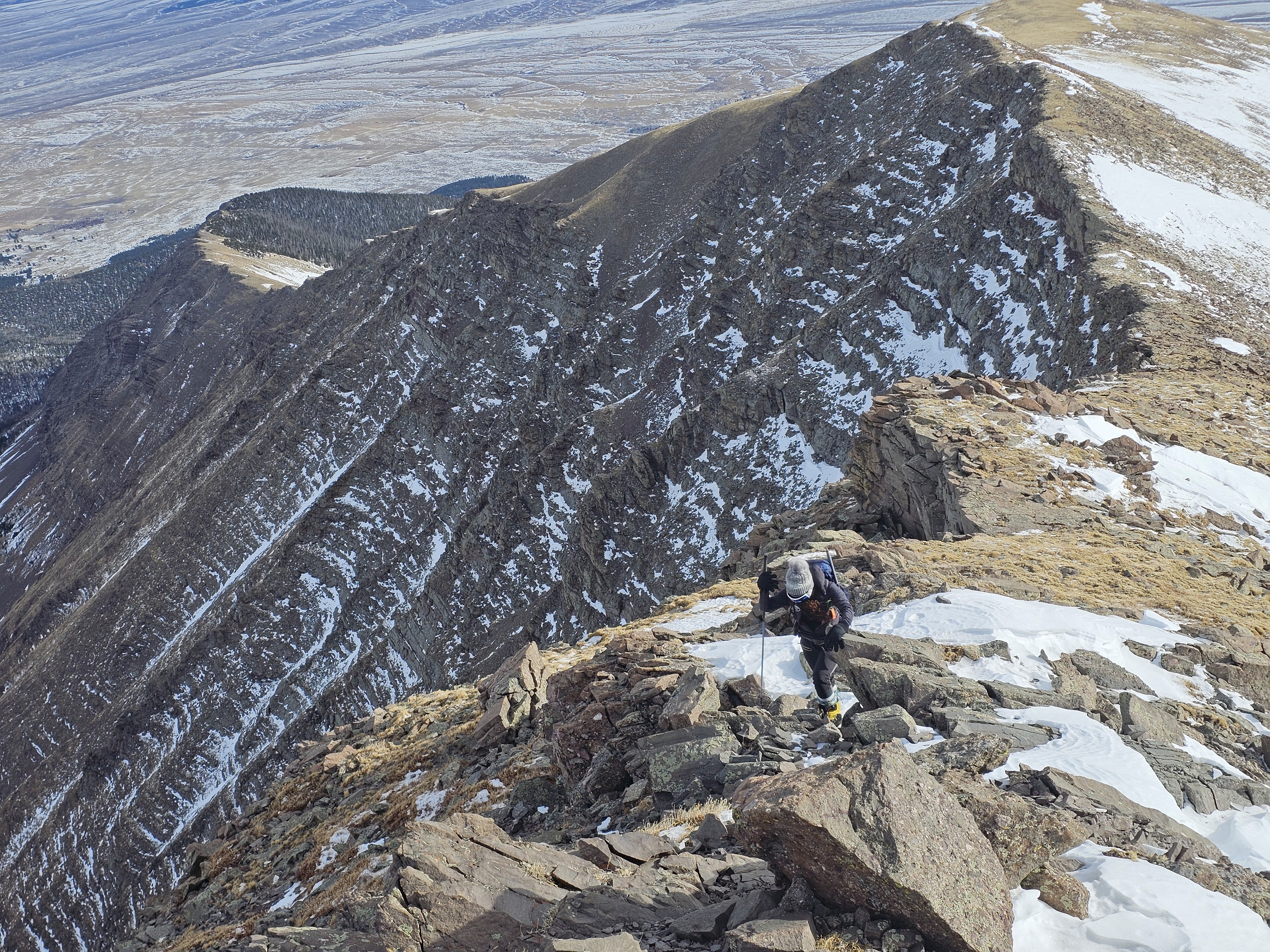
A trekker near the finish of Humboldt Peak on a winter 14er ascent.
The Best 14ers for Different Hikers
The Best Overall First 14er in My Opinion:
Handies Peak SW Slope: Located in the San Juan Mountains it is one of the prettiest peaks for our guides. The mileage is very attainable for people of average fitness. The two biggest detractions are the distance from major cities like Denver and the rough road. One of the first 14ers I tried with some friends and my wife she was white knuckling her imaginary steering wheel from the back seat. We've also had several people express how that's the roughest road they've ever been on. I've gotten most of the way to the trailhead in a Subaru but I have a lot of experience driving to 14er trailheads.
Runner Up: Huron Peak Northwest Slope
Best If You're Nervous About Your Fitness or Just Want the Absolute Easiest:
Mount Sherman SW Ridge: It's only a little farther from Denver than some of the other commonly suggested peaks. The trailhead starts at around 12,000' and with barely over 5 miles of ground to cover from start to finish it is the least physically challenging of all the 14ers that you have to walk to. The road can be a little rough but most passenger cars can get to the end. Don't plan on being alone, especially on a weekend. The upper ridge can also feel a little exposed if you're afraid of heights. The trail tends to be very good though and a good chunk of it is an old mining road.
Runner Up: Mount Democrat East Slope
Best If You Are Fit and Want to Avoid Crowds:
Sunshine's East Ridge: It's a bit of a drive if you're not in the San Juans already but you're unlikely to find another person on this route. While more commonly done in the winter and spring when the roads reaching other trailheads are closed this is starting to get much easier to follow. The trailhead is easy to get to and the mileage is fairly short but it does gain quite a bit of elevation making it a bit harder in a few spots.
Runner Up: Humboldt Peak West Ridge
Best If You Are Already a Climber And Not Interested in Just Hiking:
Blanca Peak Gash Ridge: With lower mileage than most of the other technical routes on 14ers this one will tell you if you have the fitness for anything bigger. It's only 5.0 climbing but a reasonable clearance vehicle like a Subaru can get you to the trailhead and the mileage to where you start actually climbing is comparably low.
Runner Up: Little Bear West Ridge Direct
First Time Mistakes to Avoid
I remember watching a crowd of folks head up into building black clouds on Mt. Elbert and telling me they would be fine. I remember two young ladies in running shorts ask if we were on the Keyhole Route after they (and a long line of other people) followed my headlamp to Chasm Lake because they weren't paying attention. Everyone makes mistakes but here are some of the common ones we see from first timers so you can avoid them.
Not Leaving Enough Time: If you start too early you can always relax or take more breaks. If you start too late though you may have to turn around because of storms or potentially nightfall. Unless you have an unusually good forecast in the summer you need to plan around afternoon thunderstorms so you're heading down or below treeline around noon or 1PM so you don't get chased down by lightning.
Underestimating Altitude: This we find with a lot of people from low elevation areas. They hike or walk a lot, they're athletic, maybe even run a marathon. But they've never done it with half the amount of oxygen they're used to. If you know how to calculate your speed plan on halving it for every 10000' of elevation you are above what you're used to.
Ignoring Weather: It's not the rain I'm scared of, it's what generally comes with it! A little cold rain is unpleasant and slippery. Lightning regularly kills people. For many routes you can watch how it progresses compared to your own progression and get an idea of if you'll make it quickly enough. Typically as the clouds build higher in the sky and become thunderheads it's time to turn around. On certain routes you may not have views to the west where clouds are building. Keep your ears open for thunder. Lightning commonly strikes 4-6 miles ahead of a storm. For every 4 seconds between the flash and crash that's roughly a mile. So if you hear thunder less than 30 seconds from the lightning you are in range of getting zapped.
Thinking about hiring a guide for your first 14er?
Plenty of people pick a walk-up like Sherman, start early, and have a great day on their own, and we are glad when they do. But some folks would rather not sort out the vehicle question, the start time, the altitude plan, and the afternoon weather call on their very first trip. That is where we come in. It tends to be most worth it if you are eyeing a winter ascent, something with Class 3 or harder terrain, or you want your first 14er to be the start of bigger objectives instead of a one off adventure. Mostly we just take the guesswork off your plate so you can pay attention to the climb instead of wondering whether you planned it right. If that sounds good, check out some of our 14ers climbs. Either way, we hope your first summit is a good one.
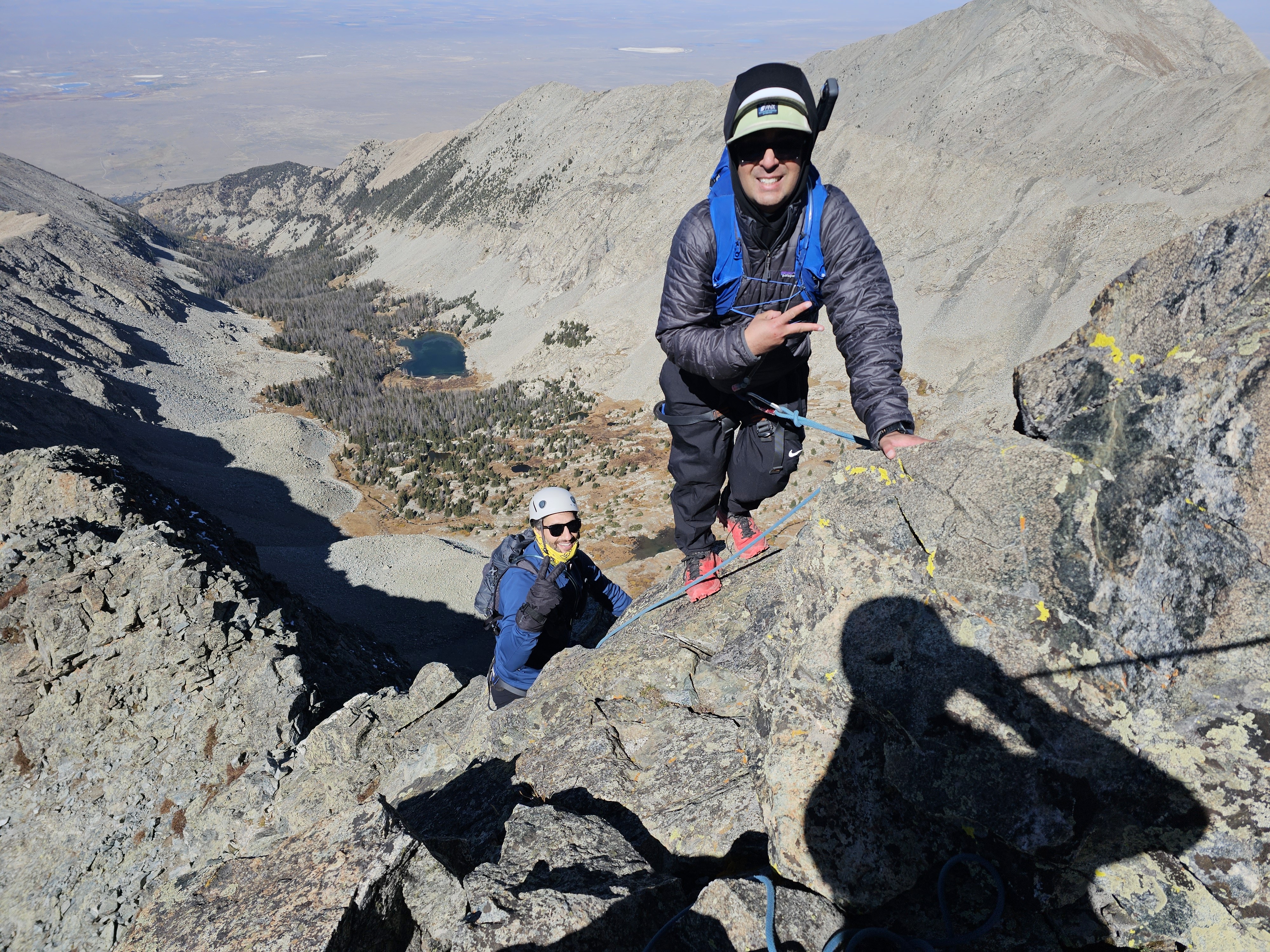
A much harder 14er near Alamosa.
Conclusion
So what is the best 14er really?
The honest answer is that there isn't one, at least not the same one for everybody. The best first 14er is the one that fits your fitness, your vehicle, your patience for crowds and exposure, and the time you actually have. Sherman if you want the gentlest day on your feet. Handies if you can handle the drive and want the mountains to knock you over with how pretty they are. Something quieter if crowds make you want to throw elbows. Run the peak you're eyeing through the same filters we do, scenery, logistics, crowds, and safety, plus the four things that make them physically hard, and you'll know a lot more than any list ranked by mileage alone can tell you.
Do that and there's a good chance you come down already thinking about the next one, which for a lot of us is exactly how this whole thing started.
What is the easiest 14er for beginners?
Mt. Sherman has the least mileage and the least elevation gain. A large portion of it is on an old mining road and it's fairly accessible. In terms of all out effort this will be easiest.
What is the best first 14er overall?
It's still an opinion but Handies is exceedingly pretty. Wild flowers, alpine lakes, colorful rocks and lichen. As a first it really gives you a lot of good reasons to want to do more. The only real downside is the driving.
Do I need a 4WD or high-clearance vehicle to climb a 14er?
For almost all the beginner ones you do not. For a few that will certainly make it a bit less stressful though. As you get into the more difficult peaks it's certainly a tool that will get a lot more use.
How do I prepare for the altitude before a 14er?
Unless you're going to rent or purchase a hypoxic tent to simulate high altitude the only way to prepare is time. The more time you spend at altitude the more your body adapts up to a certain point. Spending a few days at moderate altitudes (8k-12k) doing more moderate hikes is generally good prep.
Do I really need to start so early and be off the summit by noon?
Almost all of the summer the answer to that question is yes. Even if you're exceedingly fit and well acclimated like a lot of guides we're almost never going to get to a trailhead later than 8AM for personal trips. If you're seeing a clear forecast you may be able to start later but recognize you're taking a risk and need to be prepared to turn around when those black clouds start building. Pro tip: if your hair stands on end or you hear buzzing from metal objects that's electricity. Get down and get out before you get struck by lightning!
Do I need a guide for my first 14er?
Plenty of people do their first one without a guide. It's not particularly complicated but many people prefer the higher level of success, the additional learning, and the ease of not having to keep track of everything for their first time.
Related posts
Keep reading with connected field notes, trip reports, and climbing tips from the guide team.

How to Get Started with 14er Climbing in Winter
Learn how to climb Colorado 14ers in winter with expert tips on gear, avalanche safety, winter mountaineering skills, and the best beginner peaks.

Winter Rock Climbing In Colorado: Local Guide Tips, Techniques, and Recommendations
Discover the best winter rock climbing in Colorado, including Shelf Road, Garden of the Gods, Eldorado Canyon, and tips for climbing in cold weather.

Is Ice Climbing Right for You? Colorado’s Beginner Ice Climbing Classes Can Help You Find Out
Learn why ice climbing is perfect for beginners. Discover what to expect, what gear you need, and the best places to learn ice climbing in Colorado with a guide.


